
The Civic Association Bought Time. Cyclists Are Paying for It.
Society Hill’s $54,000 Study — and Why Pine & Spruce Riders Are Still Waiting for Protection
Byline: Joseph T. Piscitello
Week in reflection · looking back on the week of Sep 15–19, 2026
Last week, The Inquirer reported that the Society Hill Civic Association will spend about $54,000 on a new neighborhood traffic study — including a look at the city’s plan to harden the Pine and Spruce bike lanes.
On paper, that sounds like progress: more data, “fact-based recommendations,” an update to a 2018 complete-streets study. For riders who use those corridors every day, it lands differently. Safety upgrades on Pine and Spruce have been stuck since the 2024 crash and upgrade fight. Litigation and process fights keep concrete protection off the street — while people keep riding paint.
This isn’t a story about one neighborhood meeting. It’s a week-in-reflection on what happens when a fatal crash forces the city to act — and then lawsuits, loading-zone fights, and fresh “studies” stretch the timeline. Delay is not neutral. Every unprotected season leaves riders exposed.
Piscitello Law regularly represents injured cyclists and advocates for safer streets throughout Philadelphia. Our attorneys follow developments affecting bicycle safety, transportation infrastructure, and cycling-related injury risks across the city.
- Society Hill Civic Association approved approximately $54,000 for a new transportation study.
- Litigation continues to delay portions of the Pine and Spruce Street safety upgrade project.
- Federal and local research support physical separation as one of the most effective bicycle safety treatments.
- Cyclists on Pine and Spruce continue to rely primarily on painted bike lanes while legal disputes continue.
What Is Happening With the Pine & Spruce Bike Lanes?
Philadelphia has proposed safety upgrades along the Pine and Spruce Street bike lane corridor, including physical separation between vehicle traffic and cyclists. Following the July 2024 death of Dr. Barbara Friedes, the City advanced plans for loading zones, stronger enforcement, and curb-style barriers. Subsequent litigation has delayed portions of those improvements. In July 2026, a court declined to dissolve an existing injunction, and related legal disputes are expected to continue into 2027. Meanwhile, Society Hill Civic Association has approved a new traffic study examining conditions throughout the surrounding street network.
-2x.1).2609250837280.png)
Timeline of major events affecting Philadelphia's Pine and Spruce bike lane safety project from 2009 through September 2026.
Timeline Summary
The Pine and Spruce bike lane controversy stems from efforts to add stronger cyclist protections following the July 2024 death of Dr. Barbara Friedes. Philadelphia subsequently proposed concrete barriers, loading zones, and enforcement changes, but litigation delayed implementation. In September 2026, Society Hill Civic Association approved a new $54,000 traffic study while legal disputes over the corridor remain unresolved.
What the study actually covers
According to last week’s Inquirer (Sep. 17), SHCA’s board approved hiring Dewberry Engineers Inc. earlier this month. The work is meant to update a 2018 complete-streets study (Howard Stein Hudson) and gather updated traffic counts and crash data — not only on Pine and Spruce, but also on Third Street (where the city installed bike lanes in June), plus Fifth Street and Lombard Street.
Streets committee leadership framed it as gathering objective information after “significant traffic and street changes” since 2018. Fair enough: corridors don’t operate in isolation, and good engineering should look at the network.
But context matters. Last year, the same civic association contributed $25,000 toward the Friends of Pine and Spruce (FoPS) lawsuit challenging the city’s upgrade plan — including curb-style concrete barriers that would physically separate bike lanes from motor traffic. When a neighborhood group funds both the lawsuit and a new study of the same project, riders are right to treat that as bad faith: “more data” that looks less like a path to protection than a way to buy more time to keep it from happening.
The injunction vs. the barriers (plain English)
Here’s the part that gets muddied in headlines — and riders pay for the confusion.
In August 2025, Common Pleas Judge Sierra Thomas-Street issued an injunction freezing certain city work on neighborhood loading zones along Pine and Spruce — spaces meant to give residents, deliveries, and contractors a legal place to stop without parking in the bike lane. The city has treated that order as freezing its broader OTIS (Office of Transportation and Infrastructure Systems) upgrade package while the fight continued.
In July 2026, Judge Damaris L. Garcia denied the city’s motion to dissolve that injunction. The ruling was a setback for the loading-zone plan. Critically, Philly Bike Action and other advocates say the injunction targets loading zones — not a ban on concrete barriers — but the city has refused to install hard protection until it can pair barriers with those zones. FoPS’s counsel has argued the order reaches further. Either way, riders still get paint, parked cars, and door-zone risk while the case crawls toward trial (currently framed for 2027).
That distinction matters. “The court paused loading zones” is not the same sentence as “the court banned safer bike lanes.” Yet on the ground, the effect is the same: unprotected lanes, ongoing conflict, and another season of waiting. Process language softens what riders feel in traffic — a blocked lane, a swung door, a driver who never saw them.
Parking in bike lanes had been illegal citywide since 2013 — but “no parking” signs still left room for drivers to stop and block the lane. After Dr. Barbara Friedes was killed on Spruce Street in July 2024, Council passed and Mayor Cherelle L. Parker signed Bill 240657, closing that loophole by banning stopping and standing in bike lanes and raising fines. That law is on the books. The harder protection Friedes’s death also helped galvanize — concrete separation on Pine and Spruce — is still stuck in process. Studies don’t bring her back. Barriers might have changed the odds for the next rider.
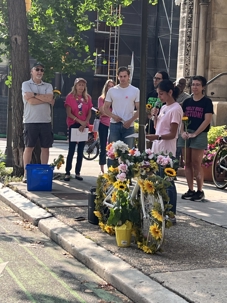
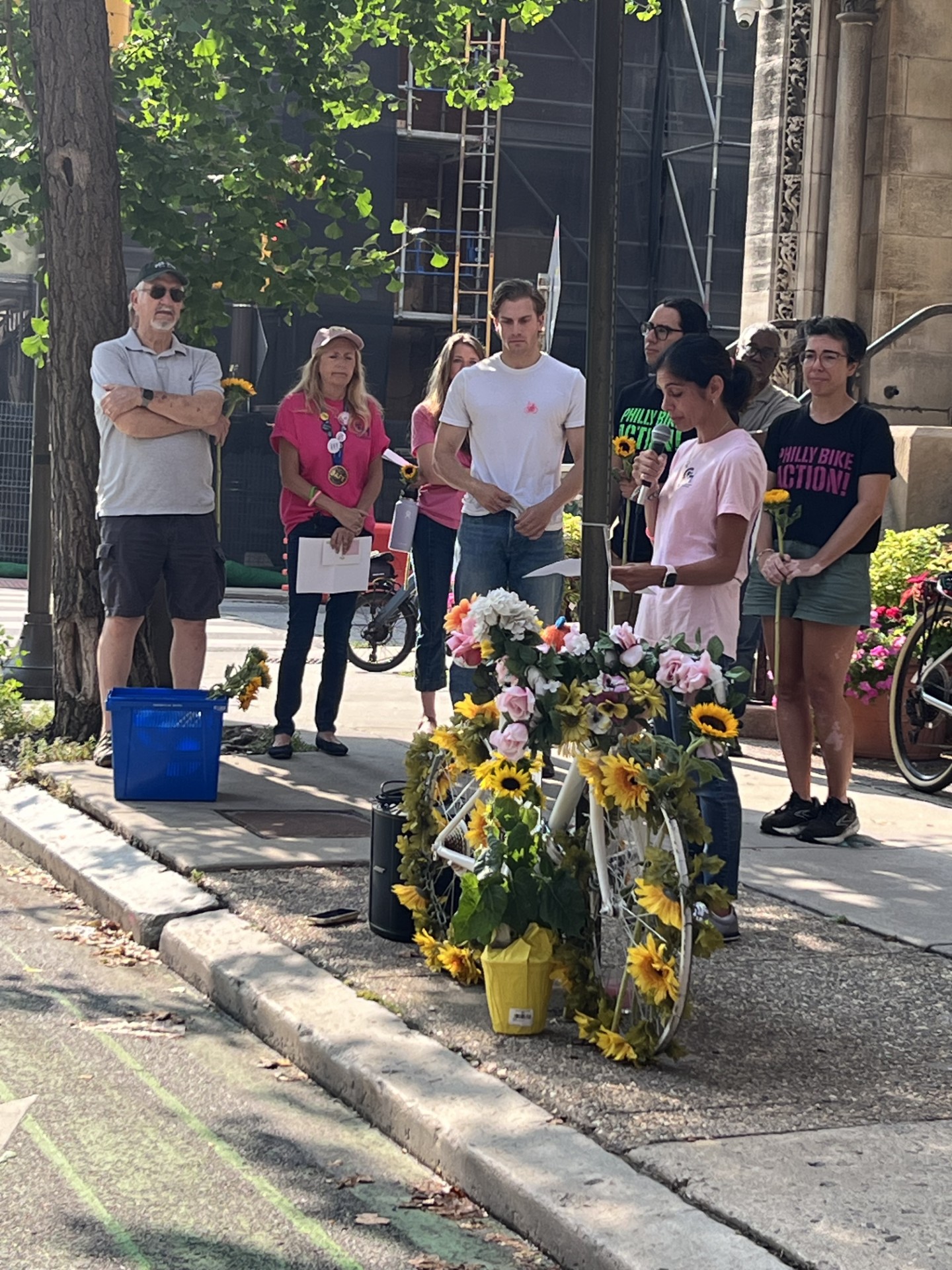 Family members, friends, CHOP colleagues, and cycling advocates gather during a July 2026 memorial honoring Dr. Barbara Friedes and advocating for safer bicycle infrastructure in Philadelphia.
The evidence isn’t waiting for another neighborhood study
Here’s what gets lost when the debate becomes another round of local “fact-finding”: the safety case for physical separation is not new, and it is not a Society Hill mystery.
National research is clear. A 2023 Federal Highway Administration study developing crash modification factors for separated bike lanes found that converting a traditional painted bike lane to a separated lane with flexi-posts cut bicycle crashes by about 50% (CMF ≈ 0.50), with related designs in a similar range. FHWA has since treated separated bike lanes as part of its Proven Safety Countermeasures toolkit. The National Transportation Safety Board concluded in 2019 that separated bike lanes can reduce bicyclist fatalities and injuries. That is not activism. That is federal safety engineering.
Philadelphia has already studied this too. The city’s Parking Separated Bike Lane (PSBL) study (field work 2020; report released publicly) looked at safety, operations, and how parking-protected designs work on Philly streets — including how to handle driveways and alleys with daylighting, sight triangles, conflict markings, and signage, rather than pretending paint is enough. On Spruce and Pine themselves, city project materials for the safety upgrade have cited FHWA findings that moving from painted to separated lanes can cut crashes by up to about 40%. The remaining design questions — loading, emergency access, driveway sight lines — are engineering details cities solve every day. They are not a reason to keep riders in the door zone while another consultant counts cars.
Driveways are a design problem, not a veto. National guidance (including AASHTO bike-facility methods and related NCHRP work) treats driveway and alley crossings as places for clear sight distance, limited parking near the curb cut, and lower turning speeds — not as proof that protection can’t exist. Philly’s own PSBL work says the same in plain terms: frequent driveways need careful treatments; they do not erase the crash-reduction benefit of vertical separation on the rest of the block.
If the research already exists, why fund another study?
To be clear: no new study is required to know that unprotected paint on Pine and Spruce keeps putting lives at risk. When a civic association funds both a lawsuit against concrete barriers and a fresh traffic study of the same corridor, riders are entitled to ask what new “facts” are left to discover — and whether “more data” is a path to protection or a way to buy more time. The safety literature already answered the big question. Barriers work. Delay doesn’t.
Related reading on this corridor and what riders can do
We wrote about this same corridor after the October 2025 Society Hill crash at Spruce and 5th, where a speeding driver tore through an unprotected bike lane — another reminder that paint is not protection on Pine and Spruce.
In follow-up coverage, neighbors and advocates (including our own Joseph Piscitello) made the same two points again: lower speeds, and permanent physical barriers — not more flex posts.
If you are in a close call or crash while these lanes stay unprotected, our Bike Crash FAQs walk through what to do in the first hours — scene safety, documentation, and why early medical records matter even when injuries feel minor.
City rules already treat cyclists as road users with the same rights and duties as drivers; knowing how Philadelphia bike laws interact with state Vehicle Code rules helps when a blocked lane or door-zone conflict turns into a reportable crash.
For a broader look at how unprotected lanes, speeding, and unsafe road design show up in bike and pedestrian crashes across Philadelphia, see our bike and pedestrian crash overview.
When a corridor stays on paint for seasons after a high-profile fatality, that gap between promised protection and what’s on the asphalt is exactly the kind of unsafe road condition riders keep asking cities to fix.
Why “studies” don’t keep you safe at 18th & Spruce
Vision Zero metrics, civic newsletters, and engineering RFPs all have a role. None of them change the physics of a door swinging open or a driver drifting into a bike lane.
Paint is a suggestion. Flex posts are a suggestion with more visibility. Concrete (or equally solid separation) is what keeps a ton of steel from occupying the same space as a person on a bike. Anything less is a compromise riders didn’t ask for — and shouldn’t have to absorb indefinitely.
When protections stall after a high-profile fatality, the public conversation often shifts to process — ADA claims, Sunshine Act arguments, parking counts, who sits on which board. Those issues belong in court and City Hall. For riders, the weekly reflection is sharper:
- Unprotected lanes still push people into traffic when blocked.
- Delay can kill, even when every filing is labeled “procedural.”
- A driver’s duty of care does not pause because a civic association commissioned a study.
- We’ll revisit after the study” is not a safety plan. It’s a calendar.
Similar “Friends of …” challenges to protected lanes have appeared in other cities this year. The playbook isn’t unique to Society Hill. What is local is the corridor: river-to-river Pine and Spruce, heavy bike volume, and a community still living with the memory of riders who never made it home.
How Barbara Friedes Changed the Pine & Spruce Debate
The July 2024 death of Dr. Barbara Friedes transformed what had largely been a transportation-planning discussion into a citywide public-safety issue. The crash increased public scrutiny of blocked bike lanes, loading activity, enforcement practices, and the absence of physical separation along heavily used cycling routes. It also accelerated calls for stronger legal protections and infrastructure changes designed to reduce conflicts between cyclists and motor vehicles.
What riders can do while the process grinds on
- Treat blocked lanes as hazards, not nuisances. Photograph, report, and route around when you can — but don’t assume the next driver will give you room.
- After a close call or crash, get checked. Adrenaline lies. Soft-tissue and head injuries often show up later.
- Preserve evidence. Photos of the scene, vehicle plate, bike/e-bike damage, clothing, and any nearby cameras matter more than a polished statement in the moment.
- Stay in the civic fight if you want to — public comment, advocacy groups, and Council still move faster than litigation sometimes — but don’t confuse activism with medical care or legal deadlines.
Infrastructure delay does not erase anyone’s duty of care on Pine, Spruce, Third, or anywhere else in this city. Until concrete protection actually lands on those streets, riders are still riding the gap between what was promised and what’s painted on the asphalt.
Summary
Society Hill's newly approved traffic study will gather updated information about several Center City corridors, including Pine and Spruce Streets. At the same time, litigation continues to delay portions of Philadelphia's planned bike lane upgrades. Supporters of protected bike lanes point to federal research showing safety benefits from physical separation, while opponents continue to challenge portions of the City's implementation strategy. Until those disputes are resolved, the debate over Pine and Spruce remains one of Philadelphia's most visible transportation conflicts.
Sources
- Philadelphia Inquirer – Society Hill Traffic Study
- Society Hill Complete Streets Study
- City of Philadelphia – Spruce & Pine Safety Upgrade Project
- City of Philadelphia – Spruce & Pine Engagement Summary
- FHWA Bicycle Lane Safety Research
- FHWA Proven Safety Countermeasures
- NTSB Bicyclist Safety on U.S. Roadways
- Philadelphia Parking Protected Bike Lane Study
- Philly Bike Action – Spruce & Pine Loading Zones Injunction Upheld
- Philadelphia Inquirer – July 2026 Pine & Spruce Ruling
- Billy Penn – Loading Zones and Pine/Spruce Litigation